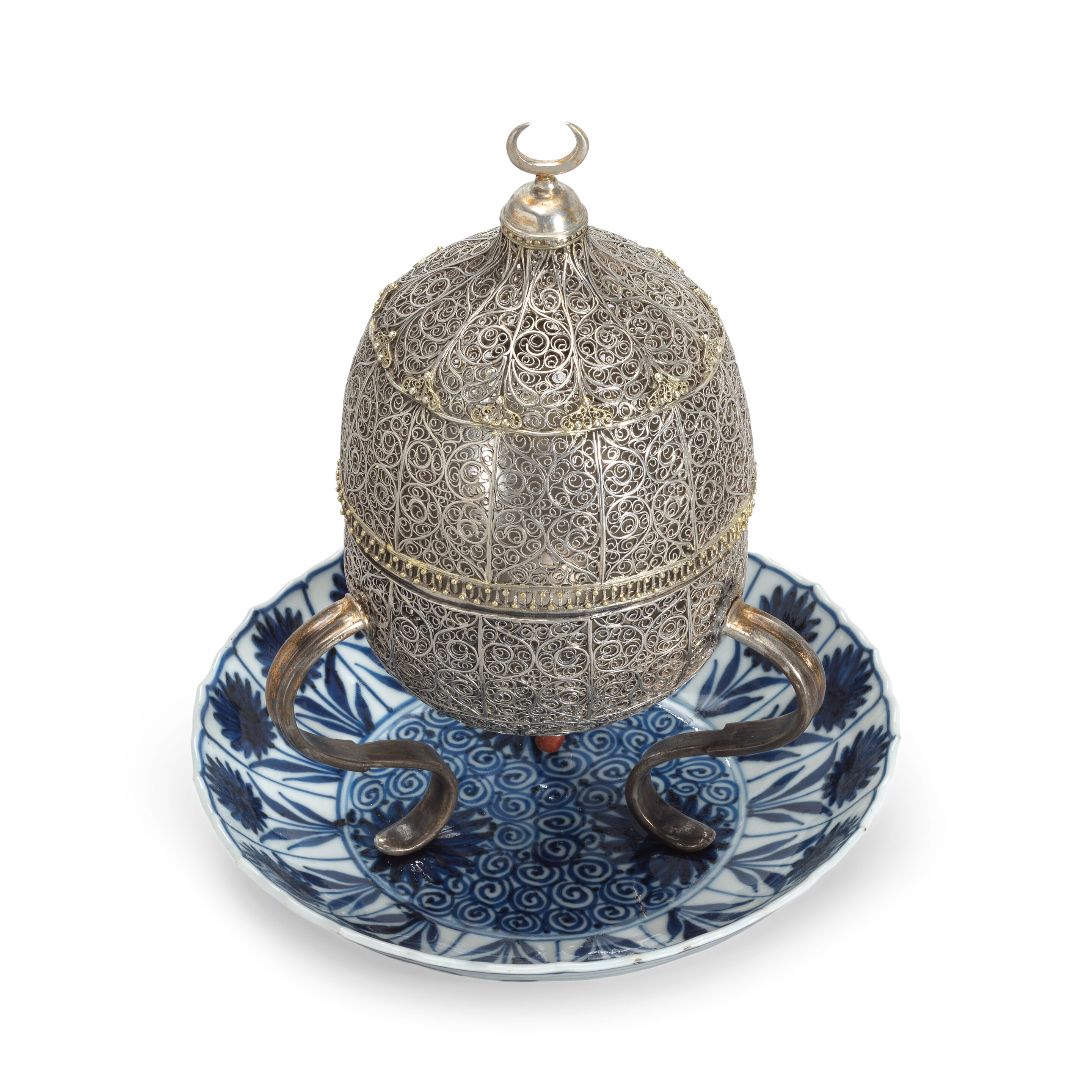
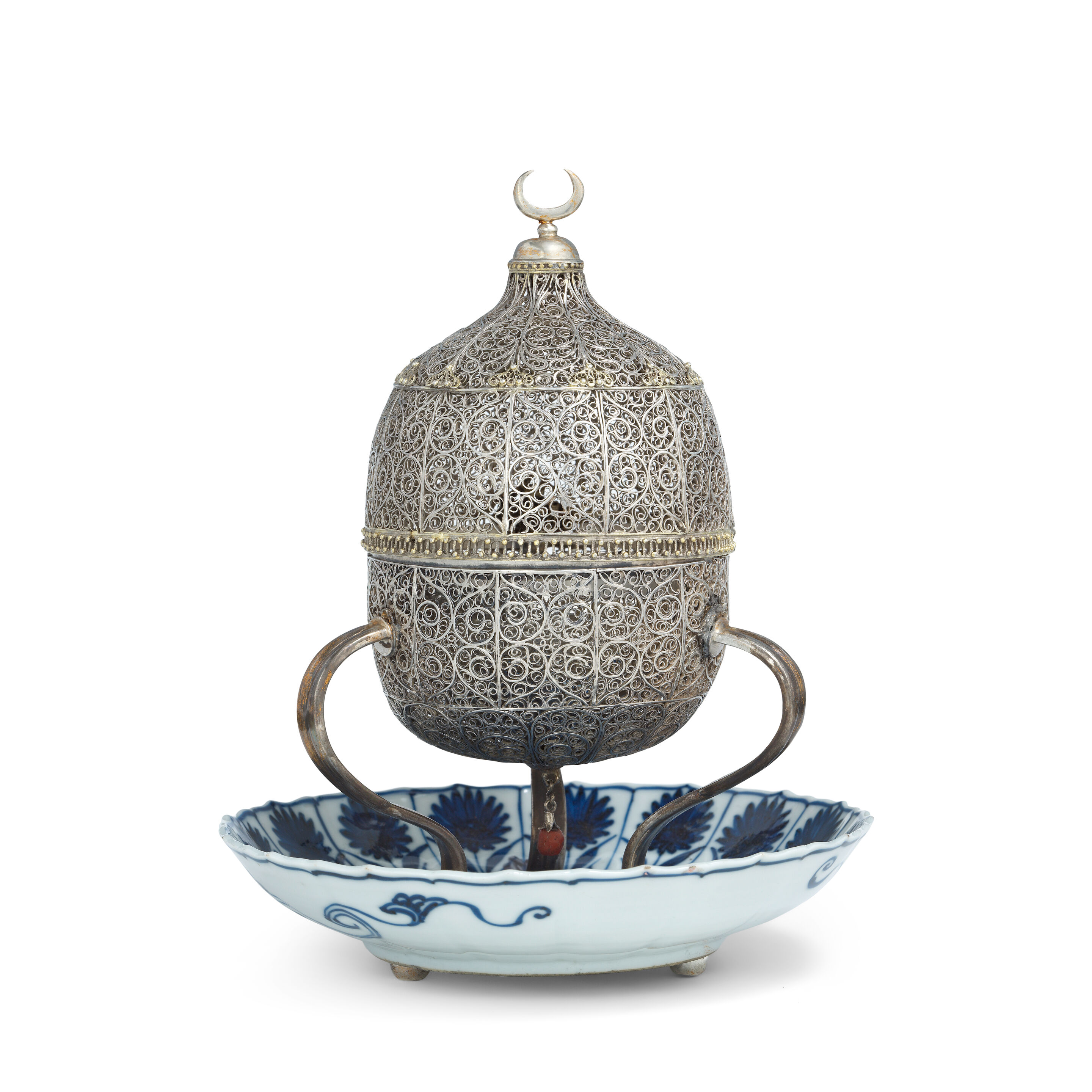
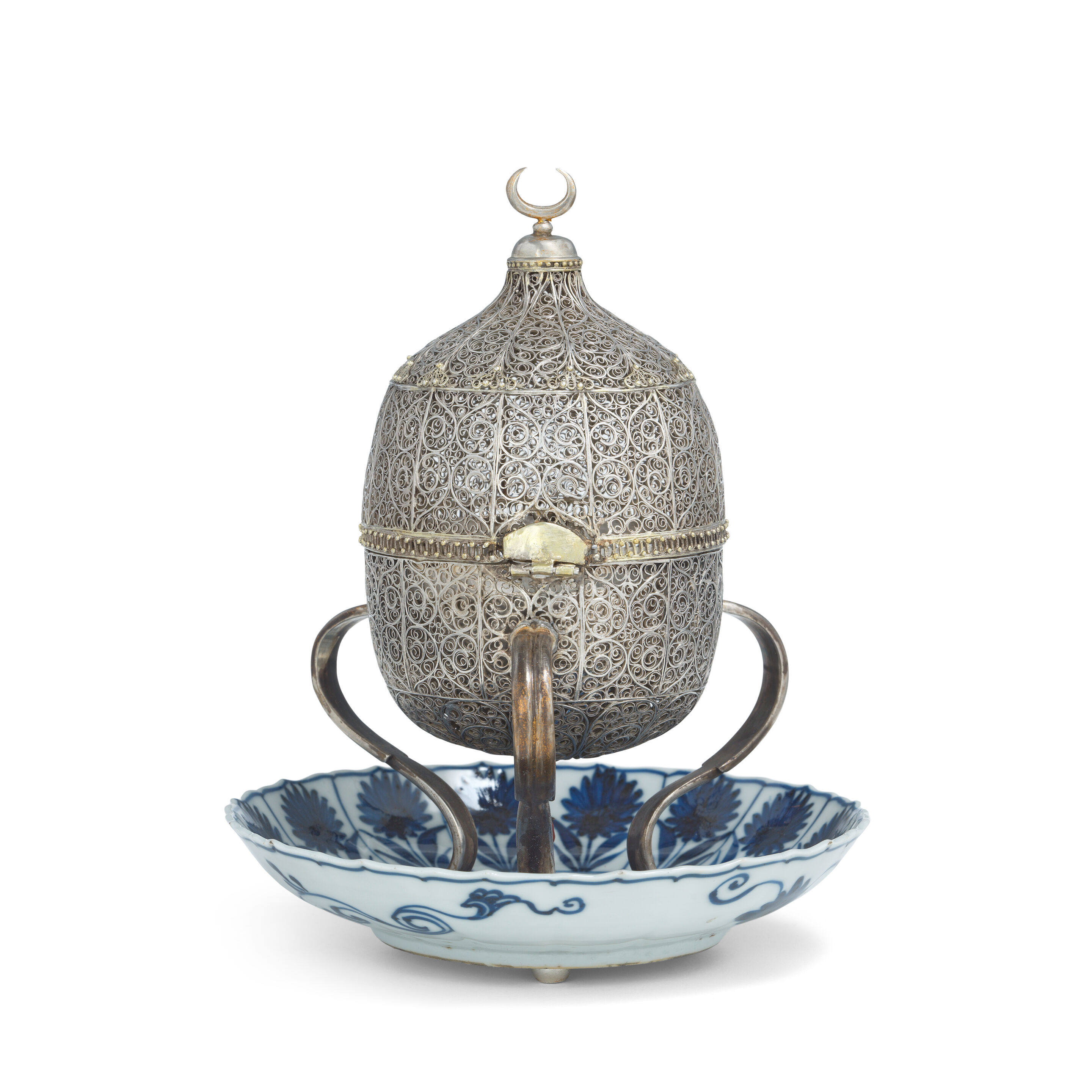
Lot 135: AN OTTOMAN SILVER FILIGREE INCENSE BURNER MOUNTED ON A KANGXI PORCELAIN DISH, TURKEY AND CHINA, LATE 17TH/ EARLY 18TH CENTURY
1 view
AN OTTOMAN SILVER FILIGREE INCENSE BURNER MOUNTED ON A KANGXI PORCELAIN DISH, TURKEY AND CHINA, LATE 17TH/ EARLY 18TH CENTURY
of ovoid form with hinged lid on three curved feet, comprising panels of filigree forming scrolling vines, surmounted by crescent, a suspension loop with hanging coral (corallium rubrum) bead to underside of body, mounted on Kangxi ‘Aster pattern’ porcelain dish with foliated rim, decorated in cobalt blue on a white ground with floral sprays to border and spiral motifs to centre, on three ball feet.
19.5 cm. high
The Ottoman world witnessed a notable influx of Chinese porcelain during the leadership of Selim I whose campaigns in Persia in 1514, and in Syria and Egypt in 1516 and 1518 obtained sixty-four Chinese porcelain objects in Tabriz and an unspecified number in Cairo and Damascus. The collections would be supplemented further by diplomatic gifts and through the process of muhallefat, or the confiscation of items, seen to have been gained at the expense of the state or which could aid the furtherance of Holy War. Unlike Europe, the Ottomans did not have direct routes to Chinese factories or trading intermediaries, meaning muhallefat was one of the key means by which porcelain became available.
Popular items converted by the Ottomans with gilt-silver mountings included incense burners, drinking flasks and wash bowls. Jean-Baptiste Tavernier (1605-1689) comments on the Ottoman tendency to pass around an incense-burner with aloes wood, so that the ‘suffumigation of the Lignum aloes not only dries up the water but also sticks so much closer to the hair of the Head and Beard.’ To read further on Ottoman use of Chinese porcelain, see Regina Krahl, Chinese Ceramics in the Topkapi Saray Museum, Istanbul: Catalogue I, London 1986, pp. 13-54.
Share this lot: